
Consider two questions:
- How often do you have the necessary operational information to make informed and effective decisions about strategy, goals, initiatives and projects that can be delivered upon?
- How often do you even know what operational information is needed to make an informed decision?
For many healthcare organizations, the honest answer is: not often enough.
Why Operational Information Matters
Studies consistently show organizations do not have access to data and information needed to make informed decisions.
- 72% of operational management professionals say they do not have access to data and information needed to anticipate disruptions and make informed decisions (2026 Operational Excellence Report).
- Nearly 70% of organizations said they do not have visibility into ongoing projects (Tempo, 2026 State of Strategic Portfolio Management Report).
- 67% of US executives claim they are not comfortable accessing or using data from their tools and resources to make [strategic and operational] decisions (Deloitte, 2019).
When asked what operational support tools are important for running a health system, the immediate responses are almost always things like the EHR, Billing, and Clinical Workforce Management systems, etc. – critical systems for supporting "front-line" clinical and patient-facing operations.
Rarely do I hear anyone include Enterprise Service Management (ESM) and Project Portfolio Management (PPM) tools. Yet, these platforms are essential for coordinating strategic initiatives, allocating resources, managing IT infrastructure, and delivering projects.
These tools provide visibility and insights into:
- What initiatives and projects are contributing to achieving organizational goals.
- How resources are allocated to initiatives and projects.
- Where competing priorities exist (conflicts and collisions).
- How organizations can reprioritize to achieve daily operational demands and organizational strategy.
Without this visibility, organizations struggle to know the necessary operational information to make informed decisions regarding investment selection and to effectively implement those decisions.
What Effective Operational Management Provides
Healthcare systems continue to invest millions in acquiring the latest clinical technologies. Yet the operational systems responsible for evaluating, prioritizing, implementing, and supporting those technologies are often outdated and inefficient – managed manually through emails, spreadsheets, siloed systems, and informal or undocumented processes and workflows.
Effective operational management requires intentional processes and practices to effectively manage day-to-day disruption rather than be overridden by it. Unfortunately, most organization’s operational processes and practices (and the tools used to support them) are too fragmented to support and properly manage strategy alongside daily demands. As a result, operational demands distract from organizational strategic priorities, slow the pace of innovation, and reduce organizational effectiveness.
That the majority of operational leaders lack visibility and awareness of initiatives and projects if often due to the organization’s use of disparate tools, isolated decision-making, and inconsistent practices.
When organizations lack visibility, they struggle to answer basic questions:
- What work is currently in progress?
- Who is responsible for it?
- How does it support strategic goals?
- What resources are required to complete it?
However, with effective operational processes and practices organizations can shift healthcare IT operations from reactive responses to providing proactive insights and information necessary for prioritizing strategy and business needs, efficiently allocating resources, decreasing incidents, accelerating project delivery, and improving digital experiences while reducing costs.
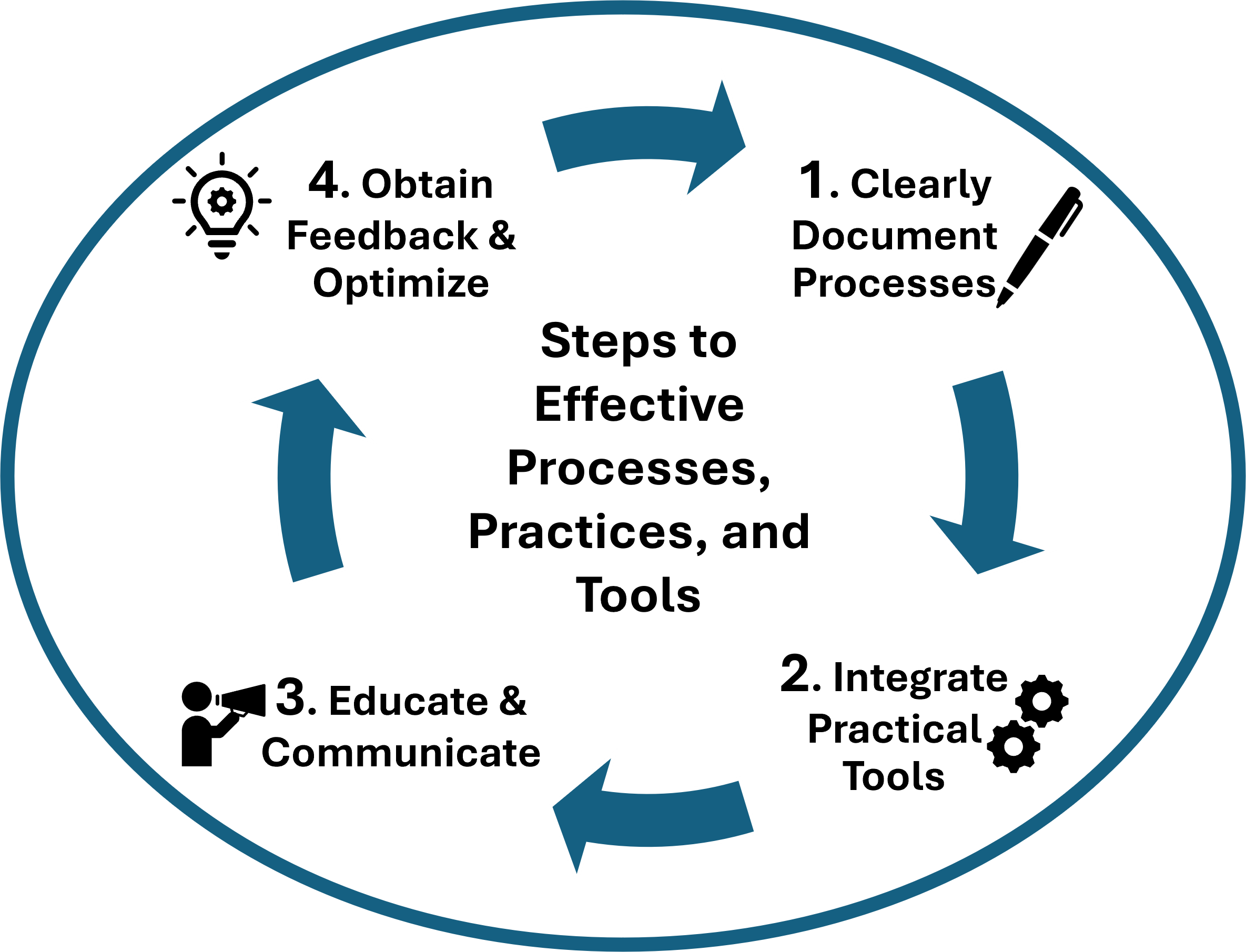
4 Steps to Effective Processes, Practices, and Tools
Establishing effective well-established practices and processes requires 4 things:
- Clear, Documented Processes. Processes should be simple, transparent, and designed to provide guidance— not bureaucratic red tape.
- Practical, Integrated Tools. Operational administrative support tools should enable and reinforce defined processes without being overly complex, costly, or difficult to use. Tools like TransIT, offered by MAKE Solutions, are designed to simplify operational workflows while maintaining the structure necessary for consistent execution.
- Continuous Education and Communication. Employees must understand the processes and the tools that support them. Operational practices cannot succeed if teams are never formally trained.
- Ongoing Feedback and Optimization. Operational practices must evolve as organizational needs, technology, and external factors change.
People, processes, and organizational politics are often the biggest barriers to following operational practices (Proactive Observability Strengthens Healthcare IT Operations, HealthManagement.org).
Documented processes supported by tools help reduce these barriers and make it easier for individuals and teams to follow established practices.
The Role of Operational Tools
Operational management support tools typically include capabilities such as:
- Request and demand intake
- Incident and service management
- Portfolio and project management (PPM)
- Resource allocation and management
- Project planning and delivery
- Workflow diagraming
- Testing and validation practices
Unfortunately, many healthcare organizations use multiple disconnected tools for these functions creating fragmentation and blind spots for monitoring work and making decisions across the organization.
Further, too often employees are not formally trained in operational processes and the tools that support them.
Ideally, consolidating operational management support tools. Tools, such as MAKE Solutions’ TransIT, provide a centralized solution to manage work, making processes visible and practices repeatable. Through tools such as TransIT leaders and team-members have a shared operational view, gaining real-time visibility into how strategy, projects, and operational demands intersect.
The benefits of consolidated operational management processes and tools include:
- Integrating information and limiting silos, duplication, conflict and collision
- Decreasing license and maintenance costs
- Simplifying training and communication
- Increasing visibility across all work being done across the organization
- Reducing conflicting and competing efforts
Integrated operational management also enables observability, supporting decision-making, resource allocation, and balance between daily operational demand and strategic goals.
How MAKE Solutions Can Help
In the years ahead, the most successful health systems will not be defined by the clinical technologies they acquire, but by their ability to operationalize and continually optimize those technologies efficiently and effectively - through informed decision-making, implementation, and operational support.
MAKE Solutions’ TransIT helps organizations strengthen these operational capabilities. TransIT provides a streamlined platform for managing the daily operational tasks of project request intake, incident and demand management, portfolio and project management, project planning and delivery, workflow visualization, and testing.
Designed to be simple to deploy and easy to use, TransIT helps organizations create operational visibility across all work being performed, enabling better prioritization, improved resource utilization, and more reliable project execution.
Review MAKE’s other articles for more insights for operational efficiency and excellence.

Talk to Our Experts
You don't have to try to figure this out on your own. Get the help you need to ensure better outcomes and be confident in your testing approach.