
Do you ever wonder how initiatives and projects are selected in your healthcare organization? Why some get fast-tracked while others—possibly more critical—seem to stall out?
The answer lies in one word: Governance.
Whether you’re a small ambulatory practice or a large health system, every organization has governance, but not all governance frameworks function well. When governance is effective, it can align projects with strategy while clarifying priorities and aiding resource allocation. In this article, we’ll break down how to design governance that works—one that drives real results and helps healthcare organizations accomplish their strategic and operational goals.
What is Operational Governance in Healthcare?
Operational governance is a sustained process and structure through which decisions are made around healthcare related investments. It defines:
- How decisions are made
- Who makes the decisions
- Who’s accountable
- How outcomes are measured and monitored
As emphasized in “Right Thing-Right Time-Right Way” and “Project Harmony: Orchestrating a Sustainable Portfolio Roadmap,” effective operational governance ensures organizational alignment with strategic and operational goals, appropriate prioritization of initiatives, and optimal resource allocation.
When done right, operational governance also provides a framework for bringing stakeholders together to identify the best operational and IT investments that will realize value and meet organizational objectives; incorporating accountability and commitment to the process.
Operational Governance Is Different from IT Governance and Project Governance
IT Governance alone is outdated in modern healthcare. Technology is part of nearly every initiative—but that doesn’t make every project an “IT project.” To succeed in today’s healthcare environment, organizations must think holistically and operationally.
Projects should not be done just for the sake of implementing technology. Separating IT project governance from overall operational governance can result in conflicting priorities, unplanned worked, resource capacity issues, increased technical debt, budget conflicts, and misalignment with organizational goals. Alternatively, treating initiatives as operational rather than strictly technological encourages alignment, avoids silos, and reduces conflict.
It is also important to differentiate Operational Governance from Project Governance. Often these two frameworks become confused. Project Governance focuses on the successful execution of approved projects, while Operational Governance is focused on selecting the right projects at the right time. Without effective operational governance working above project governance, organizations risk selecting the wrong projects entirely, creating conflict or collisions between projects, and missing out on valuable synergies.
A similar situation can occur with “shadow governance” - committees operating outside the operational governance framework that make investment decisions. Shadow governance can drain resources, derail strategy, and confuse stakeholders.
The Framework
As referenced in “What’s in your Operational Governance,” operational governance should incorporate a top-down, bottom-up approach. This ensures:
- Clinically led, business supported decision-making
- Proactive, flexible input from the ground up
- Agility and responsiveness to changing needs
By applying consistent governance practices and standards across the organization, the healthcare system can achieve greater operational efficiencies, resource synergies, economies of scale, and improved communication.
Design Governance for Effectiveness
Effective operational governance has three essential ingredients:
- Shared structure and authorized roles
- Aligned processes
- Formal organizational communication
1. Shared structure and authorized roles
Councils and committees that participate in decision making should be organized similarly to ensure fairness and communication as well as to avoid conflict or duplication across organizational decisions. Start with establishing unified charters that clarify the scope and purpose of each committee/council and include defined member roles and responsibilities for appropriate cross-organizational representation.
Further, clear operational expectations for how the committees within the governance structure function must also be defined to ease the process and administrative burden. These operational practices include voting rights and methods, attendance expectations, and committee membership rotation.
Finally, methods for communicating across committees must be established to ensure sharing of information, referral practices when decisions require representation from multiple committees, and escalation pathways for when committees need additional support to make effective decisions.

This image illustrates the recommended top-down, bottom-up structure to support coordinated and cohesive planning and communication, accountability, and value driven decisions.
2. Aligned processes
Standardized, well-documented processes make governance manageable, scalable, and transparent. Key components include:
- Intake and tracking mechanisms to properly receive and manage requests.
- Decision criteria with a formal “scorecard” to ensure consistency and transparency of decision-making processes (exploring, evaluating and selecting).
- Shared committee operations and tools to support committee processes and practices (project portfolio roadmap access, agenda and minutes templates, reporting, escalations, cross-committee communication, committee member education, etc.).
- Inclusive referral processes to efficiently engage all appropriate committees and leaders in decision making.
- Budgeting process alignment to confirm financial feasibility and ensure organizationally approved projects receive budgeting priority.
- Formal decision communication to document approvals or rejections and close requests.
- Organizational strategy awareness with clear measurable objectives for to oversee goal achievement.
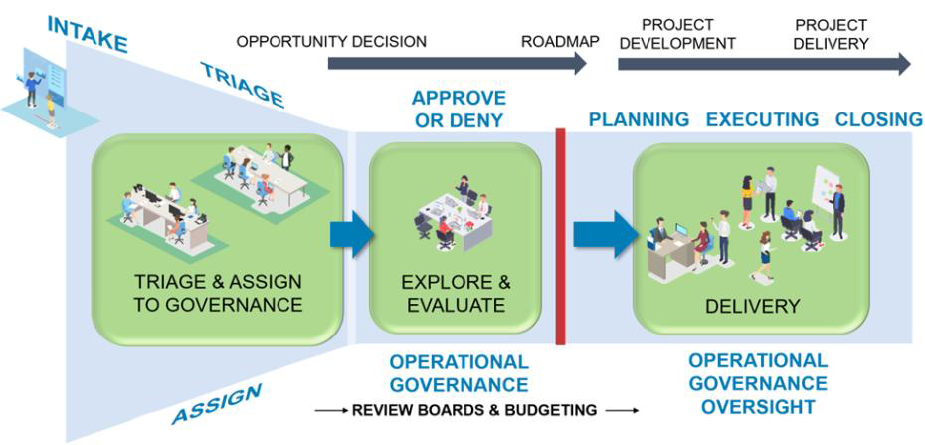
This image illustrates the recommended process for requests to be received, reviewed, and decided by Governance before starting projects– avoiding rubber stamping, ensuring consistency in decision making, and establishing priority based on benefit, staff and technical resource capacity, and budgeting.
3. Formal organization communication
Transparency builds trust. Governance decisions should be broadly communicated beyond the decision-makers.
A well-developed communication strategy guarantees governance decisions are effectively shared across the organization, fostering clarity, alignment, and resource awareness. It ensures all members of the organization understand:
- Who is making the decisions
- How decisions are made
- What decisions have been made and why
Regular communication also helps reinforce that governance exists to serve organizational interests, not individual agendas. Examples of operational governance communication include:
- Published committee structure and committee members
- Transparent Project Portfolio Roadmap of approved projects
- Defined processes for requesting initiatives and projects
- Clear success metrics for continual improvement
With the Right Structure, Governance Drives Results
When healthcare organizations design governance that’s structured, aligned, and transparent with communication, the results are transformative:
- Clearer priorities
- Smarter investments
- Better alignment
- Increased stakeholder engagement
- Reduced waste and rework

How MAKE Solutions Can Help
Want to know how your organization’s governance measures up? Take our 5-minute Operational Governance Survey to quickly evaluate your organization’s governance.
MAKE Solutions’ offers a full suite of services to support governance excellence:
- Operational Governance Discovery - A more involved free self-assessment to aid you in exploring the effectiveness of your organization’s governance processes and identifying specific targeted areas for improvement.
- Governance Education Workshops – Sessions to establish shared understanding among leaders on effective governance principles.
- Operational Governance Assessments – Expert-led evaluations with tailored recommendations and action plans.
- Governance Development Workshops – Facilitated sessions to help organizations design and implement optimized governance structures.
For more information visit MAKE Solutions or contact Tamara Pomerantz, VP Client Operations at Tamara.Pomerantz@makesolutionsinc.com.
Talk to Our Experts
You don't have to try to figure this out on your own. Get the help you need to ensure better outcomes and be confident in your testing approach.