
How TransIT Helped a Children’s Hospital Improve Patient Demographic Accuracy and Clinical Outcomes
Client Success
Overview
The Organization
A leading pediatric care hospital in South Florida is committed to improving health equity and outcomes for its diverse patient population.

The Challenge
Ensuring equitable access and mitigating health disparities among patient populations is a strategic goal of many organizations. However, this organization identified a significant gap in the accurate capture of patient Race, Ethnicity, and Language (REaL) data.
“
a better method for our organization [is needed] that will allow us to have more accurate quality data and metrics.”
This data inaccuracy created:
Challenges such as limited response options and inconsistency in data collection were impacting their ability to attain their goal. One of their physicians championed improvement, “a better method for our organization [is needed] that will allow us to have more accurate quality data and metrics.”
Why Accuracy in Race & Ethnicity Data Matters
Accuracy in REaL data is essential for understanding patient demographics, reducing disparity in outcomes, and improving healthcare delivery.
Studies show that racial and ethnic disparities lead to higher illness and mortality rates and increase healthcare costs due to excess care, lost productivity, and premature deaths (KFF, 2024). Capturing accurate race and ethnicity is essential for:
- Tailoring diagnoses and treatments
- Conducting inclusive and representative clinical trials
- Supporting health equity initiatives
Accurately capturing race and ethnicity is essential to delivering equitable healthcare, as disparities affect many conditions and outcomes—from access to care to post-treatment results (American Academy of Neurology, Neurology Clinical Practice Journal, 2024).
By focusing on improving the accuracy of REaL data captured at the point of patient entry, the organization would be able to improve efforts for ensuring health disparities are identified and root causes found and addressed.
The Solution
Enhancing the Patient Self-Reporting Process
Patients needed options and an easy entry method that that better reflected family identity and did not cause confusion, slow down the patient intake process, or lead to incorrect data entry.
The Executive Director of Community Health and Corporate Responsibility for the organization explained: “The revised REaL data collection initiative highlights the importance of creating options that better reflect family identity…adopting multi-select options aligns with best practices, ensuring families can see themselves in the available choices.” She emphasized that the success of this effort depends on both seamless integration with electronic platforms and comprehensive staff training.
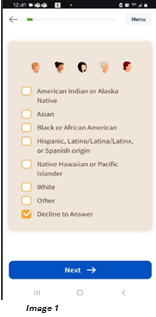
The health system changed their pre-registration system, Tonic, to allow patients to more easily and accurately self-report race and ethnicity (Image 1). “The idea is that people can be biracial or multi-racial but they usually identify as one ethnicity … and this change is to make it consistent with AHCA and CMS, and CHA PHIS reporting.”
MAKE’s TransIT software played a critical role in transforming the project.
How MAKE and TransIT Helped
The project team was experiencing challenges identifying all the various race and ethnicity combinations, testing the entry of the information, and tracking the validation of all downstream vendor systems, including the EHR and other critical clinical and reporting systems. These issues were exacerbated by the need to rebuild multiple times across several non-production environments.
By using TransIT, the project team was able to go faster, deliver better quality, improve communication, support resource management, and achieve project goals.
Streamlined Project Design and Build
TransIT was the solution to simplify and ensure all decisions were documented, data elements (data collection) were captured, and the build was tracked to completion across each environment ensuring no critical steps were missed.
Further, by utilizing TransIT the team was able to pinpoint a major problem with the project’s initial design. The project organization provided by TransIT helped them rethink the structure of the race and ethnicity fields, discovering that a combined approach reduced confusion and improved accuracy.
Consistent and Repeatable Testing
TransIT was used to track the validation of all race/ethnicity combinations ensuring testing was thoroughly completed, ensuring all workflows functioned properly - from point of entry through to all the downstream systems (see Image 2).
TransIT Plans were created to:
- Test every valid combination of race and ethnicity
- Track testing across multiple non-production environments
- Reuse testing frameworks to reduce retesting time with each environment rebuild and design change
Using TransIT Plans for unit testing ensure easy, fast, and well documented validation every time there was a change to design or build.
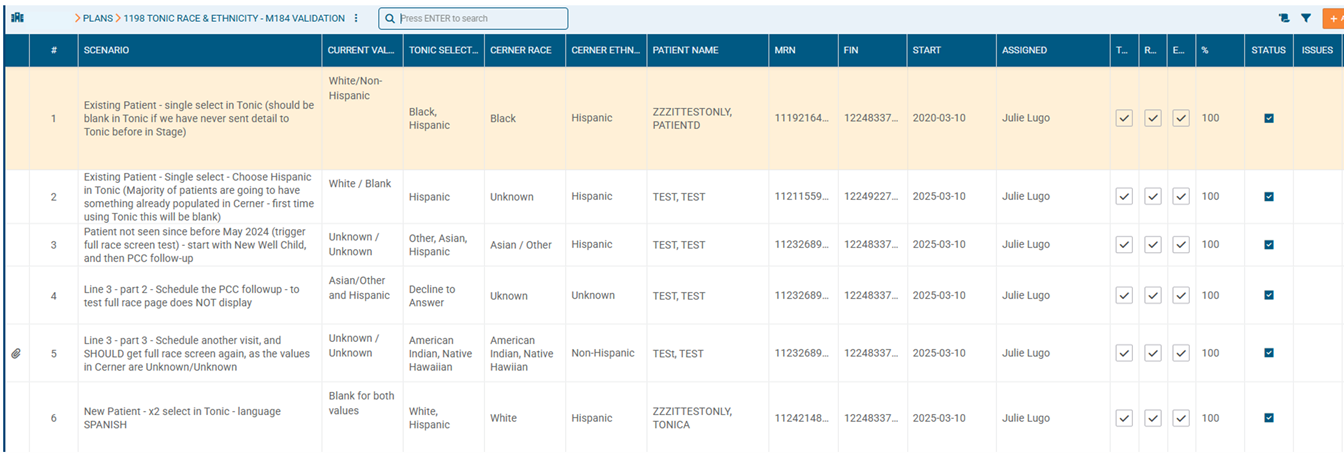
Image 2
Integrated Issue Management
TransIT’s integrated issue tracking enabled the project team to log, assign, manage, and resolve problems quickly, enabling:
- Faster turnaround for fixes
- Elimination of duplicate issues
- A documented audit trail of changes and resolutions
Improved Communication Across Vendors
By using TransIT, the project team increased communication with all the vendors involved and established transparent tracking of all build steps and testing activities. Additionally, TransIT Plans integrated with TransIT issues provided automatic notifications of issue updates further improving real-time communication.
Conclusion
Thanks to MAKE’s TransIT solution, the organization successfully transformed how they capture race and ethnicity data, leading to better clinical outcomes, improved patient and provider satisfaction, and stronger compliance with national standards.
MAKE didn’t just support the build - they empowered it with tools to plan, test, validate, and execute better.
References
- KFF, Disparities in Health and Health Care: 5 Key Questions and Answers, 2024. https://www.kff.org/racial-equity-and-health-policy/issue-brief/disparities-in-health-and-health-care-5-key-question-and-answers/#:~:text=Racial%20and%20ethnic%20health%20disparities,losses%20due%20to%20premature%20deaths.
- American Academy of Neurology, Neurology Clinical Practice Journal, Improved Accuracy/Completeness of EHR Race/Ethnicity Data, 2024. https://www.neurology.org/doi/10.1212/CPJ.0000000000200313